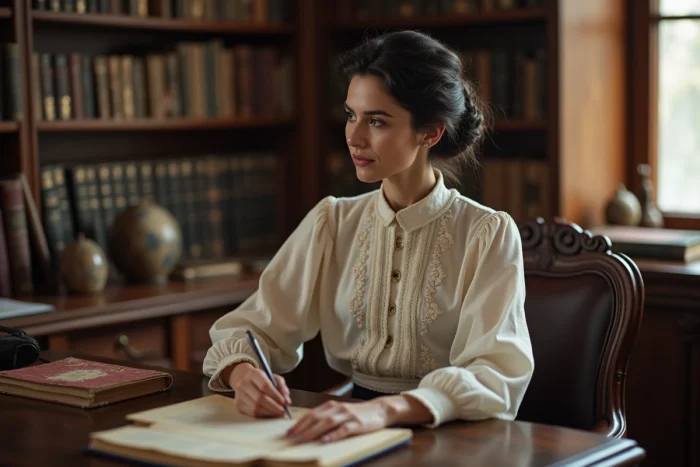
In France, early 20th-century women’s poetry often remains relegated to the background, overshadowed by omnipresent male figures. Victor Hugo, who passed away before the Belle Époque, continues to exert a lasting influence on several generations of female poets, who adapt his themes and forms to their own voices.
Why did Victor Hugo impact women’s poetry during the Belle Époque?
Victor Hugo, ubiquitous even in the collective imagination, shapes the poetic horizon of the Belle Époque long after his death. His imprint goes far beyond romanticism; he embodies a breath, a freedom of tone that attracts women poets in search of personal expression. They draw from the strength of his images, the fervor of his commitments, to make their own voices resonate. Women’s poetry then seizes upon his raw material: romantic lyricism, the quest for justice, the intensity of language, to open new paths.
The characteristics of this influence are manifold:
- Universal themes: love, freedom, social justice, fate. Women poets appropriate these subjects but transform them. Under their pen, motherhood, nature, and vulnerability gain a new dimension, far from male clichés.
- Form: ample verse, musicality, the Hugoian alexandrine. This structure becomes the foundation of bold writing, where each woman seeks her own rhythm while engaging with tradition.
This influence is never a mere copy. It opens a space of freedom, conducive to invention. Take author Cécile Sauvage on Clic et Moi: she does not simply extend Hugo’s voice; she challenges it, questions it, and puts it to the service of themes rarely addressed by her male peers. Through her verses, the Hugoian legacy nourishes a poetry that dares to embrace passion, motherhood, and pain, without ever losing its uniqueness. Women poets do not dissolve into tradition; they reinvent it and assert themselves within it, pioneers of a new literary era.
Cécile Sauvage and her contemporaries: unique voices under Hugo’s influence
Born in 1883 in La Roche-sur-Yon, Cécile Sauvage embodies this generation of women writers who, in the shadow of male canons, brought forth a moving poetry. Her trajectory, between Nantes and Paris, reveals the existence of a discreet yet solid network of creators during the Belle Époque. She writes about motherhood, nature, and the intimate, powerful themes that challenge the conventions of the time.
In the pages of Mercure de France or La Revue forézienne, Cécile Sauvage encounters figures like Anna de Noailles, Lucie Delarue-Mardrus, or Marceline Desbordes-Valmore. All seek to give the female condition and subjectivity an unprecedented presence in French poetry. The Hugoian legacy is evident in the power of the verse, but each invents her own language, surpassing the codes to explore raw emotion.
The strength of Cécile Sauvage, described by Henri Pourrat as a “poetess of motherhood”, lies in the clarity of her writing and the depth of her images. Her passionate relationship with Jean de Gourmont, revealed in Écrits d’amour (published in 2009), sheds light on a work that has long been filtered through cautious editorial choices. Her rediscovery, recently propelled by the Journées du Matrimoine HF IDF 2021 and the research of Florence Collin, reignites the question of women’s literary heritage, their visibility, and their place in the history of letters.
Here is what distinguishes Cécile Sauvage in this landscape:
- Author, wife of Pierre Messiaen, mother of composer Olivier Messiaen, she navigates modernity discreetly, yet her poetry continues to leave a mark on minds with its intensity and boldness.
Moving themes to explore: rediscovering the richness of French women’s poetry
In Cécile Sauvage, everything begins in the flesh, the landscape, the waiting. Her poetry is rooted in living matter: nature, motherhood, the experience of the body. Her collections, from L’Âme en bourgeon to Primevère, unfold a writing of urgency, where each word attempts to capture the fusion with the child, solitude, the passage of time. Here, motherhood does not adorn itself with false candor: it becomes tension, quest, trial, a source of new language.
In Écrits d’amour, the passion for Jean de Gourmont disrupts the conventional image of the wise poetess. A voice emerges that dares sensuality, spirituality, transgression, far removed from the editorial choices long imposed by Pierre Messiaen. This work of unveiling reveals a feminine poetry that, from the Belle Époque onward, breaks free from masculine norms, venturing into uncharted territories: desire, melancholy, vulnerability, everything that escapes the formatted gaze.
Two major axes permeate her work:
- Nature inhabits every page, from Vallon to Trois Muses: trees, light, wind, roots become the fabric of an intimate dialogue with the world.
- Motherhood emerges as miracle and trial, carried by L’Âme en bourgeon, praised for its accuracy and grounding in modernity.
Olivier Messiaen, through works like Le Sourire and Tombeau resplendissant, pays tribute to his mother, extending the echo of this unique voice. The words of Cécile Sauvage, long stifled, today find a rare resonance: they invite us to rethink French poetry from a new, open perspective, freed from imposed boundaries. The rediscovery of this legacy is not a step back: it is a call to finally listen to the voices that have long whispered in the margins.