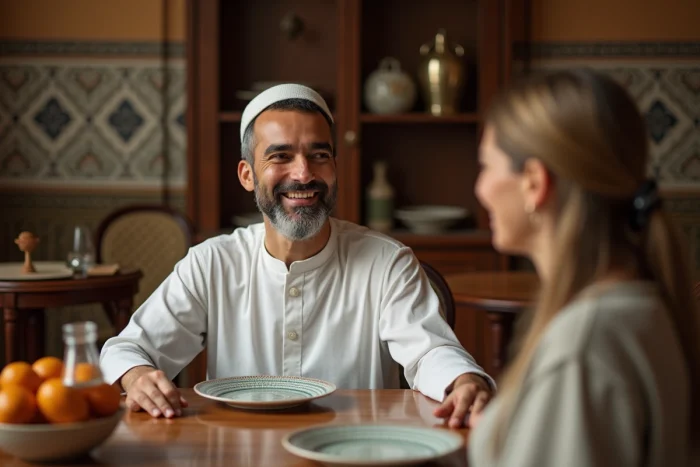
The phrase “Saha Ftourkoum” does not always call for a simple “BarakAllahou fik.” The exchanges surrounding this expression go beyond mechanical politeness and vary greatly depending on regions, generations, or the degree of closeness. Some respond with a proverb, others innovate with a touch of humor or an unexpected cultural reference. The expected response is no longer limited to a thank you: it sometimes serves as a marker of wit, complicity, or originality.
Beyond Words: Why “Saha Ftourkoum” Resonates So Much During Ramadan
To say saha ftourkoum is not to offer a mundane “enjoy your meal.” It is a phrase that circulates on everyone’s lips when the call to prayer announces iftar. Whether in the Maghreb, North Africa, or at the heart of the Muslim diaspora in France, this wish has established itself as a ritual, a bridge between generations. It encapsulates the spirit of Ramadan: sharing, brotherhood, gratitude, human warmth. A living tradition, passed down tirelessly, that anchors each breaking of the fast in collective history and attachment to the Muslim community.
By wishing “saha ftourkoum,” one conveys health, blessing, and well-being to the person about to break their fast. But the phrase goes further: it emphasizes the recognition of the day’s effort, respect for the journey taken, and the simple joy of gathering at the table. At a time when everything moves quickly, this word brings people together, connects families, and rekindles the memory of the collective.
These wishes are accompanied by simple gestures, a smile, a plate offered, a date given. The expression, omnipresent during the evening meal, reminds us of belonging to a common history, to a vibrant culture. This is all that explains why so many people wonder about the best way to respond to the famous question: what to respond to saha ftourkoum. Behind the response lies attention, a mark of respect, sometimes even the affirmation of an identity.
How to Find the Response That Truly Impresses Your Interlocutor?
To respond to saha ftourkoum in a memorable way, one must go beyond automatic replies. The Arabic language is rich in nuances, each carrying meaning and tradition. Here, the response becomes an extension of the bond, a tribute to the breaking of the fast, a way to honor the effort made and the person who offers you this wish.
Traditions favor personalization, and the range of available phrases proves this. Here are the most commonly used expressions, each suited to a particular context:
- Allah ybarek fik (“May God bless you”): conveys a sincere, direct blessing, full of human warmth.
- Barak Allahu fik: a classic variant, imbued with gratitude.
- Ftourkoum mabrouk (“May your breaking of the fast be blessed”): ideal for shared moments, this phrase emphasizes collective blessing.
- Taqabbal Allah siyamak (“May God accept your fast”): a response with spiritual significance, in line with the tradition of Ramadan.
- Saha lik (“Health to you”): simple, effective, straightforward.
Each of these responses conveys a different nuance: blessing, health, spiritual dimension. The choice depends on the relationship with the other person, the closeness, and the context of the meal. The important thing is to prioritize sincerity, adapting your response to the relationship and the moment. Ramadan is a time of sharing and solidarity that is also expressed in these exchanges, where each word perpetuates collective memory and enriches the experience of breaking the fast.

Inspiring Examples and Tips to Personalize Your Exchange
Giving a personal touch to your Ramadan wishes adds a real dimension to the exchange. The response to “saha ftourkoum” can take a thousand forms, as long as you put a bit of yourself into it. Here are some situations and tips to adapt the phrase to each circumstance:
- In a shared iftar within the Muslim diaspora, “ftourkoum mabrouk” or “Allah ybarek fik” hit the mark. The first encompasses the group, while the second addresses the individual, creating immediate closeness.
- Among close ones, a “saha lik” works well, but if you want to highlight the spiritual effort, “Taqabbal Allah siyamak” (“May God accept your fast”) resonates with depth and authenticity.
- For the pre-dawn meal, suhur, use “saha shourkoum.” This attention shows that every step of the holy month matters, not just iftar.
Sometimes, a gesture is worth as much as a word: offering dates or a glass of water before responding reminds one of the Sunnah of the Prophet Muhammad, who recommended breaking the fast this way. This detail adds an extra dimension to the exchange. The Quran repeatedly reminds us that Ramadan is experienced in solidarity, sharing, and blessing.
And when Aïd Al Fitr approaches, change the tone: offer wishes suited to the end of the month. Far from being a mere ritual, this sincere attention marks the relationship, makes it last, and lays the foundations for mutual respect that transcends the framework of Ramadan.
When the next twilight comes, there will always be a way to respond to “saha ftourkoum” that reflects who you are. It is up to each person to find their own, so that the word, in turn, becomes shared memory.