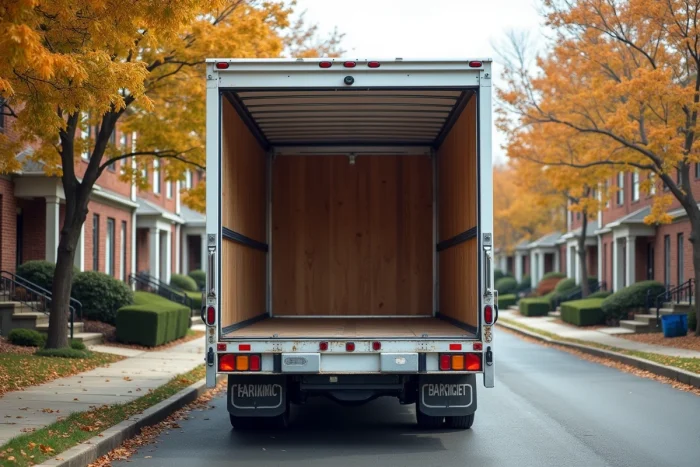
A 10 m³ truck rests on a large volume van chassis, whose GVW is almost systematically set at 3.5 tons, the maximum threshold for a B license without additional training. This regulatory ceiling conditions everything else: box dimensions, available payload, and types of transportable goods. Understanding the dimensions and capacity of a 10 m³ truck requires reasoning in terms of weight as much as volume, a reflex that most commercial sheets neglect.
Usable real volume of a 10 m³ truck: the 80% rule
Claiming 10 m³ of loading provides a theoretical indication. In real conditions, with irregularly shaped furniture, compliant securing, and dead zones created by wheel arches, the actually usable volume is around 8 m³. We recommend systematically sizing the load based on this.
This discrepancy between announced volume and usable volume is not trivial. It affects the number of trips during a move or the feasibility of a delivery in a single trip. To better understand the dimensions and capacity of a 10 m³ truck, two factors of volume loss deserve particular attention:
- Long objects (bed bases, boards, rods) that require longitudinal positioning and leave difficult-to-fill lateral gaps
- The obligation to secure the load to prevent any slipping, which requires straps, blankets, and therefore additional consumed space
- The usable interior height (generally between 1.80 m and 1.84 m) which prevents stacking certain tall furniture like assembled wardrobes
Thinking in terms of 8 m³ usable rather than 10 m³ theoretical avoids unpleasant surprises on loading day.
Payload and GVW of the 10 m³ van: weight before volume
The payload of a 10 m³ thermal van usually ranges between 1 and 1.5 tons. It is calculated by subtraction: GVW minus the empty weight of the vehicle. On a standard diesel model, the empty weight is around 2 tons, which leaves a loading margin that is sometimes reached well before the volume is filled.
A concrete example: a washing machine, a refrigerator, a washing machine, a convertible sofa, a double bed, and about twenty boxes of books easily exceed a ton. The remaining volume in the box is still available, but the maximum allowed weight is already almost reached. Loading beyond this exposes one to a punishable overload and degraded driving behavior (longer braking distances, compromised road handling).
Verification before departure
We observe that few individuals check the actual weight of their load. Public weighbridges or recycling center scales allow for quick checks. In case of doubt, it is better to remove two boxes of books than to drive overloaded.
Interior and exterior dimensions: the measurements to know
The exterior dimensions of a typical 10 m³ van are around 5.90 m in length, 2.40 m in width, and 2.80 m in height. These external measurements are important for passing through underground parking (height limits often set at 1.90 m or 2 m, thus inaccessible), narrow alleys, and standard parking spaces.
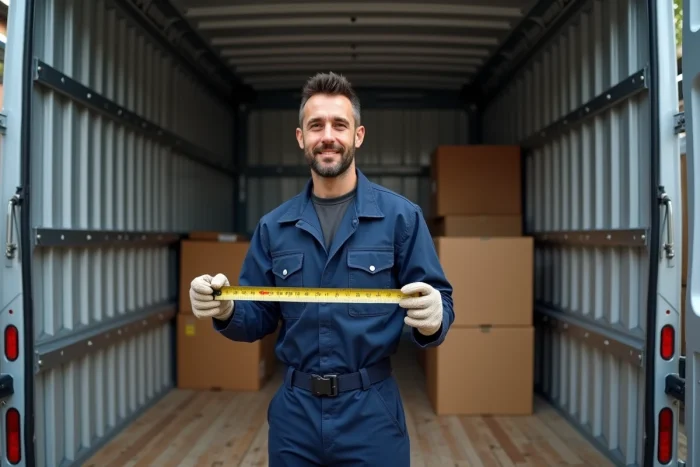
The interior dimensions of the box are what matter for loading:
- Usable length: about 3.00 to 3.30 m depending on the model
- Usable width: about 1.75 to 1.78 m, sufficient to fit a three-seater sofa sideways
- Usable height: about 1.80 to 1.84 m, which is less than the height of an adult standing in most cases
The side opening, present on most rental models, facilitates loading heavy or bulky items without having to slide them from the back across the entire length of the floor. This is a criterion to check before booking.
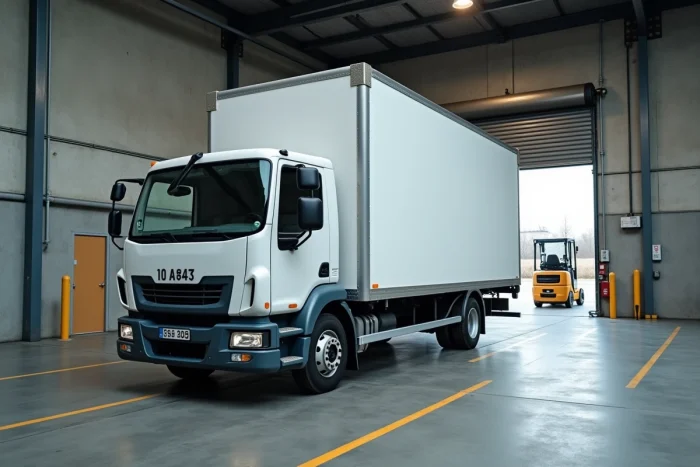
10 m³ electric truck and European regulation on GVW
Regulation (EU) 2024/1258 changes the rules for zero-emission utility vehicles. It allows, under certain conditions, to raise the GVW of electric utility vehicles to 4.25 tons while remaining under the B license (with additional training). For a 10 m³ van, this development is significant.
Batteries add several hundred kilos to the empty weight. On a 10 m³ thermal model, the empty weight is around 2 tons. On an electric equivalent, it increases significantly, which mechanically reduces the payload if the GVW remains at 3.5 tons. The increase to 4.25 tons aims precisely to compensate for this extra weight and maintain a payload comparable to that of a diesel.
This point is to be monitored for urban logistics professionals and rental companies: the first 10 m³ electric vans with this increased GVW are starting to appear in manufacturers’ catalogs. The usable payload becomes competitive against thermal, provided one has the B license and the associated training.
Adapting the 10 m³ truck to the type of transport
A 10 m³ truck covers the move of a dwelling of 20 to 30 m² (studio or small furnished two-room apartment). Beyond that, a second trip or a 12 m³ van becomes necessary. For professional transport (delivery of furniture, light construction equipment, event stock), the weight constraint often takes precedence over the volume constraint.
The 10 m³ format remains manageable in urban areas, which distinguishes it from higher categories. Its external width of about 2.40 m fits in the vast majority of urban roads. Three seats in the front allow for an additional crew member besides the driver, a concrete advantage for handling operations upon arrival.
The choice between 10 m³ and 12 m³ often comes down to a few boxes. If the estimated load exceeds 8 m³ usable (applying the 20% discount) or approaches one and a half tons in weight, switching to the higher category secures transport without disproportionate extra cost.