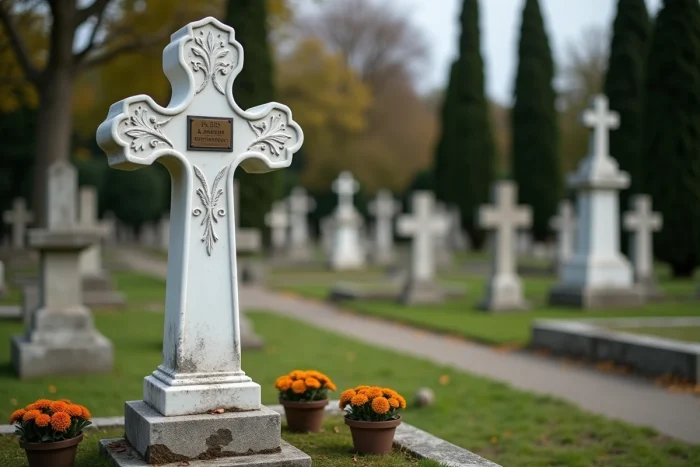
The choice of a funeral cross is often made in haste, a few days after a death, without precise knowledge of the technical or regulatory constraints specific to each cemetery. The cross remains the most common symbol placed on graves in France, but the formats, materials, and methods of attachment vary according to the type of grave, the region, and the internal regulations of the burial site.
Crosses for columbariums and cremation niches: a format under constraints
Classic guides focus on crosses intended for in-ground graves or vaults. Columbariums, increasingly present in urban and suburban cemeteries, impose radically different constraints.
The available space on a cremation niche is limited to a front plaque, often standardized in dimensions by the municipality. Crosses applied or in relief must respect a maximum projection, usually a few centimeters, so as not to obstruct access to neighboring niches. Some municipal regulations prohibit any raised elements and only allow direct engraving on the plaque.
The issue of theft is a real constraint. Small removable crosses made of bronze or brass regularly disappear from columbariums, as they are easy to detach. To address this, manufacturers offer invisible fixation crosses with a hidden dowel in the stone or plaque, making removal impossible without specific tools. Others opt for engraving or inlaying ceramic patterns, which eliminate the risk of theft while preserving the symbol.
To find out how to choose a cross for a grave suitable for this type of burial, one must first consult the regulations of the relevant cemetery, then check the allowed dimensions with the curator or the town hall.
Materials for funeral crosses: real durability depending on the climate
The choice of material is not just an aesthetic preference. Longevity directly depends on the climatic exposure of the grave.
Granite and natural stone
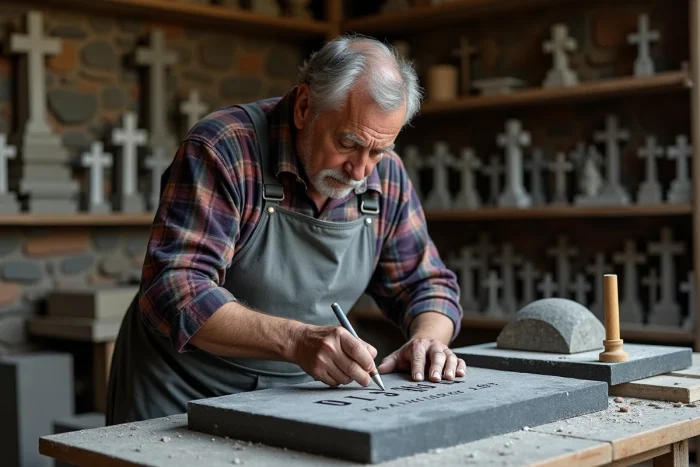
Granite remains the most common material for in-ground grave crosses. Its density makes it resistant to frost and temperature variations. Dark granites (black, anthracite gray) retain their appearance longer than lighter shades, which can stain due to moss and runoff.
Limestone, used in certain regions (Burgundy, Charentes), patinas over time and can crumble under repeated frost. Its maintenance requires regular waterproofing treatment.
Wood and cast iron
Wooden crosses correspond to a tradition still alive in rural cemeteries. Their lifespan rarely exceeds fifteen years without treatment. Cast iron, once very common, requires rust protection. Untreated cast iron degrades quickly in oceanic or mountainous climates, where constant humidity accelerates oxidation.
Stainless steel and resin
Stainless steel offers superior corrosion resistance and a contemporary appearance. Composite resin, more recent, allows for varied shapes at a lower cost, but field reports differ on its durability beyond ten years, particularly against UV rays.
- Granite is suitable for all climates and requires little maintenance, but its weight necessitates a solid attachment to the gravestone
- Wood fits into landscaped cemeteries but requires periodic replacement
- Stainless steel performs well by the sea and in the mountains, provided an appropriate grade is chosen (type 316L for saline environments)
- Resin remains the most financially accessible option for a standard format
Cemetery regulations and funeral crosses: what the town hall can impose
French funeral regulations do not impose any specific form of cross. However, each municipality sets its own rules through the internal regulations of the cemetery. These rules address several concrete points.
The maximum height of any element placed on the grave varies from one cemetery to another. A cross that exceeds the set limit may be subject to a removal notice. In confessional sections, some municipalities allow greater heights for crosses and steles, while others apply a uniform rule.
The attachment to the ground or gravestone must ensure the stability of the whole. A poorly secured cross that tips over can engage the liability of the grave’s concessionaire. Funeral homes and stonemasons know the local requirements, but checking the regulations oneself at the town hall remains the most reliable precaution.
Intermunicipal cemeteries add a layer of complexity, as the regulations may differ from those of the deceased’s municipality of residence. In municipalities that manage multiple sites, the rules are not always identical from one cemetery to another.
Personalization of a grave cross: engraving, ornamentation, and limits
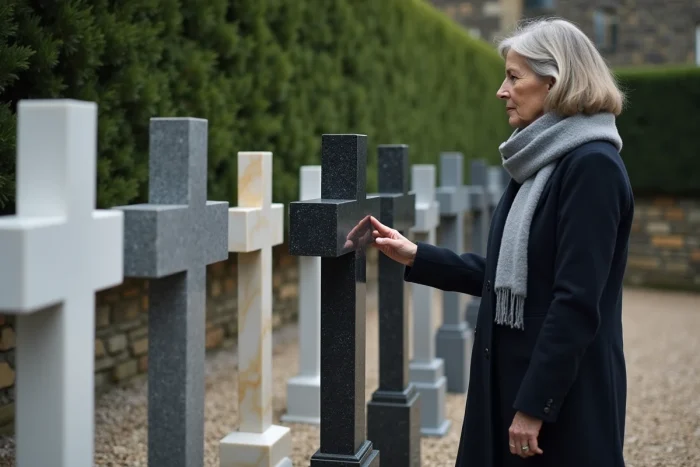
The personalization of a funeral cross goes beyond the choice of shape. Engraving the name, dates, and an epitaph remains the most frequent request. On granite or marble, the engraving lasts several decades. On wood or cast iron, the painting of the letters requires refreshing every few years.
Attached ornaments (ceramic photo medallions, enamel plaques, bronze flowers) allow for personalizing a standard cross without ordering a custom model. A ceramic photo medallion withstands the elements better than a classic photo frame, but its attachment must be designed to prevent theft or detachment.
- Laser engraving on granite offers superior precision to manual engraving and allows for detailed patterns
- Personalized funeral plaques with photos are fixed by gluing or with stainless steel screws depending on the support
- Real bronze ornaments patina over time, which is part of their aesthetic, but annual cleaning with neutral soap is sufficient for maintenance
The choice of a cross for a grave commits the family for several decades. Taking the time to consult the cemetery regulations, compare materials based on the local climate, and plan an attachment method suitable for the type of burial, including for columbariums, avoids disappointments and early replacement costs.