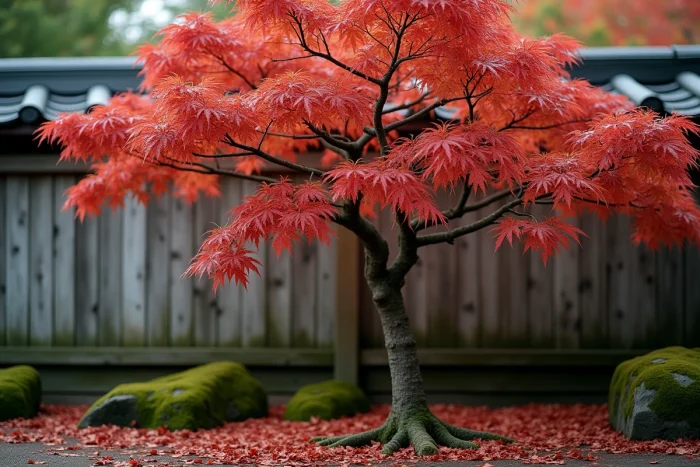
The Japanese maple (Acer palmatum) is a deciduous tree. The shedding of its leaves in winter is part of a programmed physiological mechanism, not a dysfunction. Yet, every autumn we see the same concerns among homeowners, often fueled by a confusion between normal seasonal leaf drop and pathological decline.
Leaf abscission in Acer palmatum: the hormonal mechanism at play
The winter leaf loss of the Japanese maple is based on an abscission process controlled by the balance between auxins and abscisic acid. When the photoperiod decreases and nighttime temperatures drop, the synthesis of auxins in the leaf blade slows down. Abscisic acid takes over and activates the formation of a abscission zone at the base of the petiole.
This layer of cork cells gradually cuts off the sap supply to the leaf. Chlorophyll pigments degrade, revealing the anthocyanins and carotenoids responsible for the characteristic scarlet, orange, and purple hues of Acer palmatum. The leaf eventually detaches under its own weight or by the action of the wind.
That the Japanese maple loses its leaves in winter does not indicate any pathology: it confirms that the tree is entering dormancy properly. Recent horticultural references unambiguously classify Acer palmatum among the deciduous species.
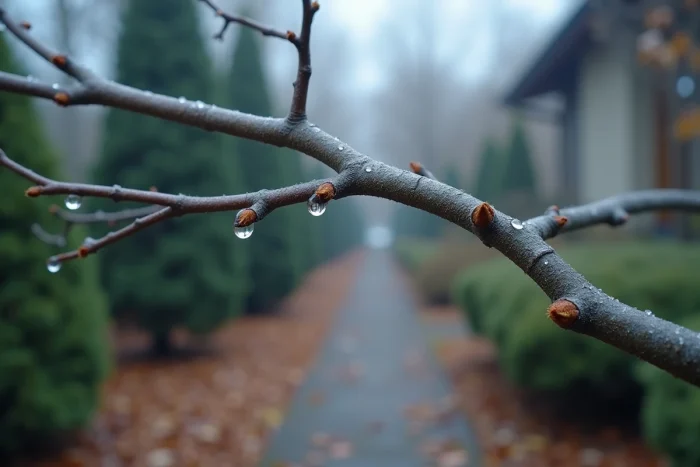
Dormancy disrupted by mild winters: an underestimated risk for the Japanese maple
The Japanese maple needs to accumulate a sufficient amount of chilling hours to complete its dormancy and restart properly in spring. Recent studies, including one published by INRAE on climate and ornamental trees, document the effects of milder winters on ornamental woody plants.
A deficit of winter chill causes irregular leaf drop. Some leaves remain attached late in the season, while others fall in successive waves. The tree never fully transitions into vegetative rest.
The consequences manifest in the following season: delayed bud break, weak shoots, increased susceptibility to fungal diseases. We recommend monitoring the behavior of your maples at the end of autumn. Foliage that persists beyond January in a typically cold region signals a problem with cold accumulation, not a particular hardiness of the tree.
False winter leaf drop triggered by autumn drought
Since the repeated drought episodes in France, nurserymen and gardening networks have observed a distinct phenomenon: early defoliation as early as September or October, well before the cold. The tree sheds its leaves due to water stress, not due to entering dormancy.
The trap is to confuse this drop with the natural cycle. A maple that loses its foliage in mid-summer or early autumn while nights remain mild is experiencing a root-level water deficit. The substrate is dry at depth even if the surface appears moist after a light rain.
Soil, substrate, and roots: factors that accelerate or delay leaf drop
The foliar behavior of Acer palmatum directly depends on soil quality. An unsuitable substrate alters the defoliation schedule and the tree’s vigor at spring restart.
- Substrate pH: the Japanese maple thrives in acidic to neutral soil (heath soil, humiferous soil). A calcareous soil blocks iron absorption and causes chlorosis, which accelerates leaf drop well before winter.
- Drainage: waterlogged soil suffocates fine roots and can trigger abrupt defoliation. In pots, ensure that the bottom of the container allows for free drainage of water.
- Organic mulching: a layer of dead leaves or pine bark retains soil moisture in summer and limits thermal shocks to the roots in winter, two factors that stabilize the dormancy cycle.
- Rooting depth: in pots, the limited volume of soil amplifies temperature and humidity variations. A potted maple loses its leaves earlier than one planted in the ground, because its roots experience more pronounced stress.

Exposure and winter protection of the Japanese maple in pots and in the garden
Exposure plays a direct role in the timing of leaf drop. A maple planted in full sun in southern France experiences summer thermal stress that depletes its reserves. The foliage scorches as early as July, and the tree enters a survival state well before autumn.
Partial shade remains the reference exposure for Acer palmatum. A location protected from direct sunlight between noon and four o’clock, with sufficient brightness in the morning, allows the tree to maintain its foliage until the first frosts.
Winter protection for potted specimens
A potted maple exposed to frost without protection risks not losing its leaves (that’s already done), but having its roots damaged by the cold. We recommend grouping pots against a wall facing east or south, and wrapping the container with a winter cover or bubble wrap.
The substrate should not be waterlogged at the onset of winter. Reduce watering as soon as the tree has lost the majority of its foliage, while maintaining slight moisture to prevent complete drying of the roots.
Distinguishing normal leaf drop from decline in Japanese maple
The question arises every year on specialized forums. Here are the sorting criteria we use to differentiate the two situations:
- Progressive and colorful drop (green to yellow, orange, red, then brown): normal cycle. The tree shows no signs of distress.
- Leaves that dry in place without coloration, remain attached, and turn brown within a few days: water or thermal stress. Check the soil at depth.
- Leaves spotted with black or covered in white powder before dropping: likely fungal attack (anthracnose, powdery mildew). A copper-based treatment may be considered after complete leaf drop.
- Branches that do not bud in the following spring: the problem lies not with the leaves but with the roots or the collar. Check the condition of the root system.
A healthy Japanese maple completely loses its foliage every winter and produces new leaves as soon as temperatures rise above the bud break threshold. This annual cycle, far from being a defect, ensures the longevity of the tree and the quality of its autumn colors from year to year.