
The association of a letter with a color does not stem from any linguistic or universal logical necessity. Yet, some educational systems assign a hue to each character, while others see it as an aberration. Neuroscience researchers have noted that grapheme-color synesthesia affects about 1% of the population, although its brain mechanisms are not fully understood.
In typography competitions, there are no official rules prohibiting the integration of color codes into lettering, but this practice remains marginal in Western tradition. The question remains open: why do some cultures or disciplines continue to blend the alphabet with the color palette in this way?
When Letters Take on Colors: A Dive into the Fascinating World of Alphabetical Hues
Synesthesia intrigues with its ability to silently link words to shades. This phenomenon, far from being rare, unfolds its ramifications across more than sixty different forms. Letters, numbers, days of the week, sounds, geometric shapes: the list grows, with each category sometimes becoming the stage for an unexpected dialogue between perception and meaning. The associations between colored letters and chromatic sensations are not mere fleeting fantasies: they impose themselves, constant and singular, on those who experience them.
Take Madeleine B., for whom each word floated in the air, haloed by its own hue. Madame C. saw numbers align in a farandole of distinct colors. As for Solomon Cherechevski, he relied on these correspondences to build an exceptional memory, with each piece of information attaching itself to a unique sensory image.
The history of arts and letters is full of creators who have explored these color-letter associations. Rimbaud, in “Voyelles,” assigns each vowel its own hue, a gesture echoed or reinvented by Baudelaire, Nabokov, or Kandinsky. For these artists, color perception invigorates the creative act: the letter becomes pigment, the word, palette. Carol Steen translates onto canvas what she sees internally; Sibelius composes in shades; Théophile Gautier, during his experiments, described worlds where colors, sounds, and flavors intertwined.
Sometimes, a letter opens the door to a strictly personal chromatic universe. In children, these links emerge early, influenced by their learning style or cultural environment. When discussing color in H, we touch upon the diversity and depth of these correspondences, between history, sensation, and subjectivity. Synesthesia is not merely a curiosity; it questions the boundaries between art, language, and brain exploration.
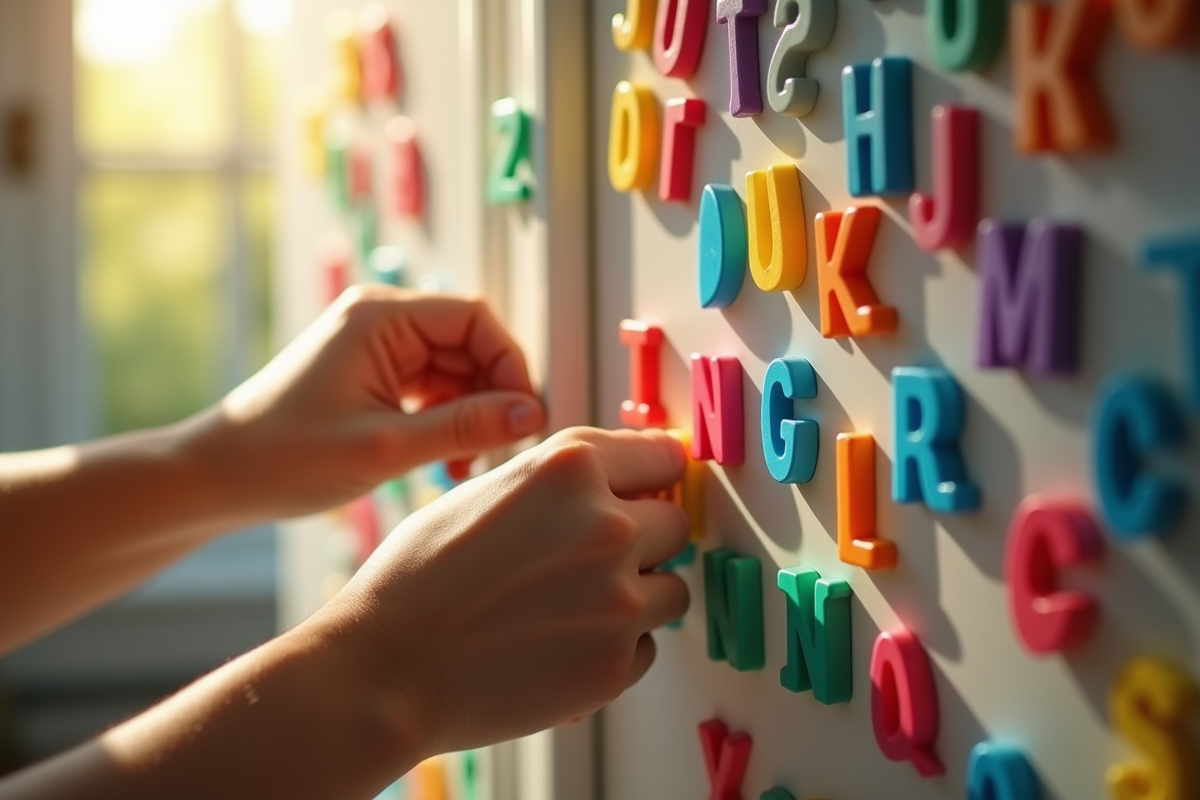
Synesthesia, Creativity, and Memory: How the Colors of Letters Influence Our Perception
Neuroscience tackles synesthesia head-on and examines its repercussions on memory, creativity, and sensory perception. Jean-Michel Hupé, in Toulouse, observes how these automatic and personal links transform a simple letter into a visual experience. Edward Hubbard has shown that, for some, looking at black numbers is enough to activate the brain areas dedicated to color, indicating a special dialogue between different regions of the brain, particularly in the left temporal lobe.
The tendency towards synesthesia may have a genetic component and predominantly affects women. Childhood influences also play a role: a colored alphabet, a unique teaching method, and the letter becomes imbued with a red, a blue, a yellow that will never leave it. Once established, these links resist the test of time. The synesthetic brain thus becomes a fertile ground for creation, but also for an extraordinary memory. Solomon Cherechevski is a striking example: he was able to retain vast amounts of information thanks to mental images saturated with colors and shapes.
To illustrate the concrete effects of synesthesia on daily life, it is useful to list some findings from research:
- The work of Mike Dixon and Thomas Palmeri has shown that synesthetes locate a letter or number in a set more quickly due to the perceived color.
- Recognition and recall of information are accelerated, which can be a significant advantage in certain learning or memorization situations.
- Conversely, this personal system of correspondences can sometimes complicate reading or navigation when the visual environment does not match the synesthete’s internal palette.
Most studies agree that these sensory experiences enrich the lives of those who experience them, even if the mystery of their deep origin remains. This dialogue between the senses, far from being limited to a neurological singularity, invites us to rethink our relationship with language, memory, and creation.
As letters don colors in the minds of some, one question remains: what happens to words when each character, beyond meaning, is imbued with a secret hue? For those who see the alphabet in this light, reading will never be quite the same again.