Excessive stimulation can hinder a baby’s natural curiosity. However, a lack of targeted interactions slows down certain motor and sensory acquisitions.
Recent studies reveal that the regularity of small routines plays a more significant role in the development of toddlers than the accumulation of sophisticated activities. Even simple gestures, repeated every day, promote the construction of solid references and encourage gradual autonomy from the earliest months.
Understanding Baby’s Awakening: Why Every Step Counts
The development of a baby progresses in stages. At each level, new horizons open up. From the very first days, everything begins with an avalanche of sensations: a tender voice, light filtering in, a hand gently placed. Gradually, the child ventures into their first gestures, initially hesitant but crucial for gross motor skills and fine motor skills. Taking the time to observe each progress, even the most subtle, offers the child a foundation of emotional security and gradually stimulates their autonomy.
Every baby follows their own pace. Some move quickly, eager for novelty, while others prefer to repeat the same action over and over, as if to better tame it. Whether it’s free movement or more guided support, an adapted environment remains key: a clear space, a few varied objects within reach, allowing for exploration with confidence. It’s better to prioritize quality sensory and motor experiences rather than multiplying stimuli.
Sharing observations with other parents, discussing daily questions, helps refine understanding of baby awakening. To find references, there are many resources, such as discovering the Carnet de Bébé website, which offers practical advice tailored to each age and concrete examples to support the child over the weeks. The essential thing is to remain attentive to the signals from your baby, adjust stimuli to their needs, and keep in mind that every micro-progression contributes to the child’s confidence… and to the parents’ serenity.
What Routines and Tips Facilitate Daily Life with a Toddler?
Living with an infant means juggling consistency and adaptation. Establishing reassuring routines structures the days and provides the child with reference points. The evening bath, care and massages, and the bedtime ritual become anticipated moments that gradually consolidate emotional security. Repeating the same gestures with kindness offers the toddler a gentle transition between different phases of the day.
To lighten daily life and gain serenity, here are some practical tips to consider:
- Anticipate diaper changes by preparing the changing mat, wipes, and spare clothes. A well-organized changing table transforms this sometimes delicate moment into a controlled routine.
- Using babywearing, in a wrap or ergonomic carrier, strengthens the parent-child bond while providing the adult with appreciated freedom of movement.
- Vary resting positions: bouncer, floor space, arms, to encourage motor skills and give your baby the opportunity to discover their body in different ways.
The transition to solid food proves to be a significant milestone. New tastes, new textures to explore, while keeping breast milk or formula at the center. Observing your child’s reactions, gradually adjusting foods, turning mealtime into a moment of exchange, all contribute to their sensory awakening.
The choice of environment is non-negotiable: simplicity, safety, and a calming atmosphere take precedence over an abundance of objects. A clean, well-thought-out space supports autonomous discovery and nurtures the toddler’s self-confidence.

Simple and Fun Activities to Stimulate Awakening Day After Day
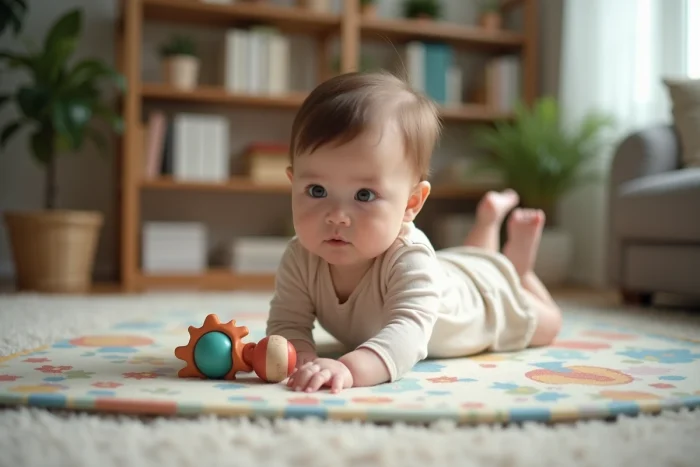
It is the small repeated games and the diversity of discoveries that nourish your baby’s awakening day after day. Prioritizing short but frequent activity times, adapted to the child’s alertness, makes all the difference. At the heart of this dynamic, the play mat placed on the floor quickly becomes a rallying point. The child enjoys valuable freedom of movement, ideal for developing gross motor skills and fine motor skills. Barefoot, they discover textures, reliefs, temperature variations, in direct contact with the world around them.
To accompany these moments, a few simple objects are more than enough. No need for excess: a rattle to shake, a ball to catch, blocks or shape boxes. Sensory toys, crinkly fabrics, teething rings, soft plush toys, multiply the opportunities to stimulate touch and hearing. Installing an unbreakable mirror within view attracts curiosity, encourages the child to look at themselves, discover their own expressions, and engage in early imitation games.
Music naturally invites itself into daily life. Alternating nursery rhymes, lullabies, and everyday sounds, singing or simply naming gestures, objects, and people, stimulates language awakening and strengthens the parent-child bond. Talking to your baby is planting the seeds of future communication, awakening the desire to exchange and open up to others.
The arrangement of the baby’s room or the play area deserves reflection. Organizing distinct spaces, a reading corner with a few board books, a zone for free movement, a nook dedicated to cuddles, offers the child a thousand opportunities to explore according to their desire and pace.
In the end, it is these daily gestures, these tiny attentions, that leave lasting impressions. A child’s awakening does not rely on excess but on listening, consistency, trust, and that invisible thread that connects parent and baby through discoveries.